Essay Three | Topped Out: Tetris Level Burnout

During the summer of 2022, I made the decision to begin working from a co-working space in Nelson, BC. Around the same time, a small group of other people also began working at the space. And by the end of that summer, genuine friendships and connections were emerging. I still work there today, approaching four years now, and the core community of coworkers and friendships has remained.
From the outset, the observatory deck I described in the first essay of this series was quietly active. From that interior vantage point, I found myself making observations about the small group of people who had, in their own distinct ways, figured something out. Not the same things, not all at once, and none of them completely. But what accumulated across weeks and months of observation was a growing recognition that different people had meaningfully figured out different components of something I had been searching for, without quite having the language to name it.
One person had a remarkable relationship with rest and integration. They were genuinely unhurried in a way that wasn’t passive, but rooted in some quiet confidence that stepping away from the work was itself part of doing it well. They seemed to understand, at some level I hadn’t yet fully operationalized, that restoration was not the reward for completed work but a structural prerequisite for all forms of work. When they were present, they were fully present. When they stepped away, they stepped away completely. There was no visible guilt in either direction.
Another had an unusual clarity about what they were responsible for and what they were not. Not a coldness or a rigidity, but much more like a settled honesty about the shape of their obligations. They seemed to know, without apparent anxiety, exactly where their responsibilities began and ended. The ambient dread I had come to recognize in myself—the sense that everything was always slightly on fire somewhere—was simply absent from how they operated.
Another had made some quiet peace with confrontation. Difficult conversations, avoided tasks, decisions that most people defer indefinitely, all seemed to be treated not as exceptional ordeals that required exceptional courage, but simply as a category of work that needed to get done, like any other. They addressed things directly and without drama, and moved on. The accumulation of unfinished difficult business that I carried like background noise didn’t seem to be part of their experience.
And then there was someone whose days appeared to be organized around a principle I had encountered before but not yet fully applied: that different kinds of work requires different kinds of attention, and that mixing them indiscriminately costs something.
Creative and strategic work occupied protected blocks. Genuinely protected, and not squeezed between other things. Administrative and operational tasks were batched together in their own time, separate from the creative, addressed with a no-drama recurring cadence. The logistics of life outside work—household, family, personal administration—had their own designated space rather than bleeding into everything else. Evenings and weekends held intentional room for family and connection, not as what remained after the rest was handled, but as something that had been given its own protected claim on the calendar. And woven through all of it was time spent in the forest and mountains. Not occasionally, not as a reward for a productive week, but with a regularity that suggested it was considered genuinely necessary. Time for processing and integrating. Time for the kind of unhurried presence that suggests genuine restoration rather than mere escape from obligation.
Professional boundaries were clear and consistently held. Not apologetically, not with lengthy explanation, simply as a given. And on the desk, always, a well-worn physical notebook. Not decorative, but a finely tuned working instrument for thinking and planning and executing. A place where the day was given its shape before being lived, rather than discovered in real time through whatever happened to arrive first.
What I was observing was not people who had figured out something I had never considered. I had been thinking about how to steward a life well since my late teens. I knew something about purpose and vocation. I was present with my children and engaged in my work. I understood, at least in principle, why the work mattered beyond the work itself. I was trying, genuinely and persistently, to hold it all together. And so, what I was seeing, was not the presence of something I entirely lacked; rather, it was the presence of a more complete and integrated architecture than I had yet managed to build.
Where I had foundations, they had also built the walls. Where I had some of the rooms, they had also figured out how the rooms connected. Where I had effort and intention and purpose orientation, they had—and this is what gave me pause—structures that were proportionate to what they were actually carrying. That was the gap. Not virtue. Not values. Not effort, but structure.
And the question that formed across those months of observation was not how to become a different kind of person. It was how to build a more complete and proportionate version of what I had already begun.
What would need to change in my own life to achieve something like this?
Not any specific person’s approach. Not a particular notebook or schedule. But the orientation taken as a whole. The relationship between a person and their responsibilities. The sense that the life was being carried rather than dragged behind. And with renewed urgency, I came back to that word I had been circling for years without fully inhabiting—stewardship.
Three Words Defined
I want to define three words that will carry significant weight throughout this series. Each has been used in enough other contexts to have accumulated connotations that may or may not align with what I mean.
The core questions this series is dedicated to exploring, the one that has been quietly present since the first essay, is this:
What does it actually mean to steward all the active domains of one’s life well, and what sort of intentional architecture can be constructed that is proportionate to the responsibilities carried, that honours fundamental human capacities and the inherent need for margin, and that allows a person to move through their life with clarity and peace rather than perpetual fragmentation?
Three words sit at the centre of that question:
stewardship, architecture, and proportionate.
By stewardship, I mean the practice of carrying well that which has been entrusted to you. Your time, your relationships, your skills and abilities, your responsibilities, with the recognition that you are accountable for how you carry them.
I do not merely mean management, control, efficiency, or survival. The word stewardship has deep roots in philosophical, spiritual, and theological traditions spanning centuries. The idea of being given something of genuine value to tend, not merely to own or consume, and being answerable for what you did with it. Translated into the language of ordinary life, stripped of any one particular philosophical framing, stewardship means carrying what is yours to carry with intention and wisdom, oriented not just toward your own flourishing but toward the flourishing of those in your care and the communities you belong to. It implies a relationship to responsibility that is neither white-knuckled control, nor passive drift, but active, considered, and aligned with who you actually are.
By architecture, I mean a deliberately designed, interdisciplinary structure that holds and organizes the full complexity of a life, in the same way that a building’s architecture holds and organizes space. It is not a single system, a narrowly defined habit stack, methodology, or an isolated productivity framework.
Architecture encompasses principles, rhythms, habits, tools, and the relationships between them, analogous to how a building contains structural elements like its foundation and load-bearing walls, functional elements like rooms and corridors, and the logic that connects them into something coherent and liveable.
The architecture of stewardship is not a set of rules imposed from the outside. It is a structure built to fit your actual life, that is designed by you, for you, proportionate to what you are actually carrying. Something you operate within throughout life, rather than something external that is prone to being set aside or forgotten.
Proportionate refers to the relationship between the structure and the load it must carry. A structure is proportionate when it is adequate to hold what is being carried without the person being crushed beneath it, but also not so elaborate that the structure itself becomes a burden.
Proportionate implies calibration to the specific person and their specific life. A person navigating a season of moderate complexity needs a different architecture than a person carrying high complexity across many simultaneous domains.
The architecture must fit the life, not the other way around.
A couple more notes on stewardship before we move on. Stewardship is not productivity. It is not optimization. It is not the efficient processing of inputs and outputs. Those things all have their place and we will get to them, but they are instruments and tools, and not the point.
The point is something far closer to what it means to live well with what you have been given to carry. And that question, of what it means to live well, is one that this series will return to, from multiple angles, as the architecture begins to take shape.
Freedom, we established in the previous essay, is not the absence of constraints but the presence of the right ones. The cellist who submits to the discipline of daily practice in order to perform at a concert level. The athlete who sets aside certain legitimate wants in pursuit of others that are prerequisite to what they most deeply desire. The constraints are not the enemy of the life they want. They are a fundamental part of the architecture that makes it possible. And stewardship is the ongoing practice of choosing, with intention, which constraints actually fit, and then honouring them, even when the easier path is available, even when no one is watching, even when the urgent is louder than the important. It is not perfection. It is not the absence of difficulty or complexity or failure. It is the presence of an intentional structure, a collection of core cadences, carefully chosen constraints, an interconnected architecture of capacities, principles, and habits, that is proportionate to what is being carried, and that preserves the conditions in which a whole life can actually flourish.
Ultimately, stewardship is not something some people need and others don’t. I believe it is a feature of what it means to be a finite, embodied, socially embedded human being, carrying genuine responsibilities across space and time.
Every person who carries real obligations—to their children and family, to their life partner, to their vocational work, to their community, to themselves—is already stewarding, whether they explicitly name it or know it or not.
The question is not whether you are a steward—that much is settled. It is part of the human condition. The question is whether you are stewarding with intention or by default.
I will develop this argument more fully in the next essay. For now I wanted to name it clearly, because it frames everything that follows.
Sustained Fragmentation
There is one remaining facet of the problem I have not described fully in this series yet, and not because I have been avoiding it, but because the first two essays were building toward it, and now we are here. And still, part of me wants to skip this part, mostly because I am eager to get to the building phase of the series.
That said, I think this series will benefit from one last stop with the problem.
I will begin with a brief and honest note about an image I used in an earlier essay. I described the experience of jumping off a cliff into adult responsibilities and scrambling to build an airplane before running out of altitude. It captured something true about urgency and desperation—the freefall, the improvised assembly, and the hope that something airworthy would emerge in time. But sitting with this series longer, I have come to think that the image has a critical limitation. An airplane assembled in freefall is built for one purpose, and that is to survive the immediate drop. It is a crisis response, not a design for the journey.
Instead, there is another image I have been contemplating for some time, and I do think it is more accurate.
For thousands of years, from the Mediterranean shipbuilding traditions of the Bronze Age and classical era, through the Phoenicians, the ancient Greeks, and the maritime civilizations that followed, the construction of a wooden ship was among the most deliberate and demanding acts of human craft.

A large vessel could take years to build and the labour of hundreds of skilled workers. Ship builders would search for timber with specific natural curves, called compass timber, to fit precise structural needs. The keel was laid first, the foundational spine, upon which everything else depended. From the keel up, plank by plank, each joint was cut with precision and locked in place so that no single weak connection could compromise the whole.
The knowledge was passed down through generations of apprenticeship. And importantly, a ship was designed for specific waters. A vessel built for coastal trade was different from one built for open ocean passage. The architecture was proportionate to the journey. That is the image I would rather lean into. Not the airplane scrambled together in freefall, but a ship that is built deliberately, from the keel up, designed for the actual waters ahead.
When there is no ship, or when the ship you have was built for calmer waters than the ones you find yourself in, a recognizable pattern tends to unfold. It begins with what I have come to think of as Responsibility Fracture, which refers to the specific moment when the accumulation of legitimate obligations across multiple life domains crosses a structural threshold. The load has grown but the structure has not kept pace.
The person is still functioning, still showing up, still trying hard, but something has shifted. The improvisational approach that worked well enough at lower load levels is beginning to show its limits. The cracks are not yet visible to others. But the person carrying the load knows something has changed. This is the beginning of fragmentation, the ongoing lived state of a life whose architecture is no longer proportionate to its load. And left unaddressed, Responsibility Fracture tends to spread. The urgency cycle tightens. Important but not urgent work gets perpetually deferred. The confrontation list grows. The margin narrows until it effectively disappears. And then the nervous system makes a decision on your behalf.
Think of Tetris at the highest level you can handle. The pieces are falling faster than you can place them. You are making real decisions, good ones even, but the speed has exceeded your capacity to respond with any artfulness. The screen is filling. Every gap you clear reveals three more forming above it. There is no breathing room. And then at a certain point it is simply over. Not because you stopped trying. Because the pace exceeded the architecture available to manage it. Topped out.
Clinical burnout is not tiredness. It is not ordinary stress. It is something more fundamental. It is the nervous system reaching its structural limit and responding with the full weight of what that looks like. The psychiatrist and researcher Dr. Stephen Porges, whose polyvagal theory has significantly advanced our understanding of the nervous system, describes three distinct states of nervous system response. The first is a state of safety and social engagement, the condition in which we do our best thinking, our most creative work, and our deepest connecting. The second is sympathetic activation, the fight or flight response, useful in genuine acute threat but corrosive when sustained chronically. The third is dorsal vagal shutdown, the freeze response, a kind of collapse that the system initiates when the threat load has persisted past the point where fight or flight can address it.
Clinical burnout, in this framework, is not a motivational problem. It is the nervous system’s last resort, a structural response to a structural problem.
Peter Levine, Ph.D., whose foundational work on somatic experiencing has shaped trauma and stress research for decades, observed that the body keeps a running account of unresolved stress in its tissues, its breath, its posture, its capacity for rest. The symptoms of chronic overload are not random. They are the body’s precise and faithful report on the gap between what is being carried and the structural capacity available to carry it.
I know this not theoretically, but personally. The chest tightening that arrives not from exertion but from a system running past capacity for too long. The particular quality of sleeplessness that comes not from stimulation but from a nervous system that cannot locate the off switch. The difficulty concentrating, the tasks started and abandoned, the inability to sustain attention on anything long enough to finish it. The meals skipped not from discipline but from an inability to pause long enough to eat. The body, in other words, becomes the reporting mechanism for a gap the mind has been unable to close, carrying in its symptoms the precise shape of what is structurally missing.
I think it is worth pausing here on something increasingly relevant in the current moment. Many of these symptoms, from difficulty concentrating, inability to complete tasks, restlessness, the sense that the mind is everywhere and nowhere, overlap significantly with how attention deficit disorders present clinically. In an era of algorithmically harvested attention, always-on connectivity, epidemic levels of structural overload, and apps deliberately engineered to fragment focus, it is worth asking honestly: how much of what is being diagnosed as a neurological deficit is also, at least in part, the predictable cognitive output of a nervous system operating chronically past its structural limits?
I took the question seriously enough to have comprehensive psychological testing done. A thorough assessment, conducted by a psychologist, with a clear result: not ADHD.
What I was experiencing was not a neurological deficit. It was a structural one. The architecture was not proportionate to the load, and my nervous system was reporting that fact faithfully and loudly.
I am not dismissing the reality of attention disorders, they are real and they matter. But the overlap is worth naming, and I suspect that the structural question deserves to be asked, alongside the neurological one, before conclusions are drawn.
And rest, within the context of Tetris Level Burnout, when it finally arrives in such a context, it does not feel like rest. It is more of a numbness. A flatness that no vacation can remedy, because after the vacation, you know you will be returning to the same unarchitected life, the same structural deficit, the same gap between what is being carried and the capacity available to carry it. For me, the problem was not, at the core, the absence of a holiday. The problem was the absence of a foundation.
I remember at various points longing not for a week away, but for something more like three years. Some sort of supernatural absence of all responsibility, long enough to actually recover. Which of course is not available to most of us. And which, I came to understand, would not have solved the problem anyway. The problem was structural. A three year vacation returns you to the same ship.
And in this state, the people around you who love you, can begin to show the quiet fatigue of witnessing a pattern that never quite resolves. I kept deferring connection, thinking I’d reach out once things stabilized, once things were more under control. I didn’t know how to explain to the people closest to me how much I was carrying or how difficult things had actually become.
There is a scene in the old television programme I Love Lucy, the one where Lucy and Ethel are working on a chocolate assembly line. The chocolates come slowly at first, then faster, then impossibly fast, until the only option is to stuff them anywhere available, just to keep pace. I think of that sometimes. Managing the surface. Maintaining the appearance of composure. Shielding people from the chaos. But it was taking its toll. The conveyor belt was running faster than the architecture could manage. I don’t think that fragmentation and burnout are character flaws. They are not the result of insufficient discipline or weak willpower or poor values. The people I have observed entering this territory, and I have observed many, including in the mirror, are almost uniformly among the most diligent, conscientious, and well-intentioned people I know. The problem is not who they are. The problem appears to be structural. The architecture is not proportionate to the load. And when that gap persists long enough, something breaks. The ship doesn’t sink because the captain stopped caring. It sinks because it was never built for these particular waters.
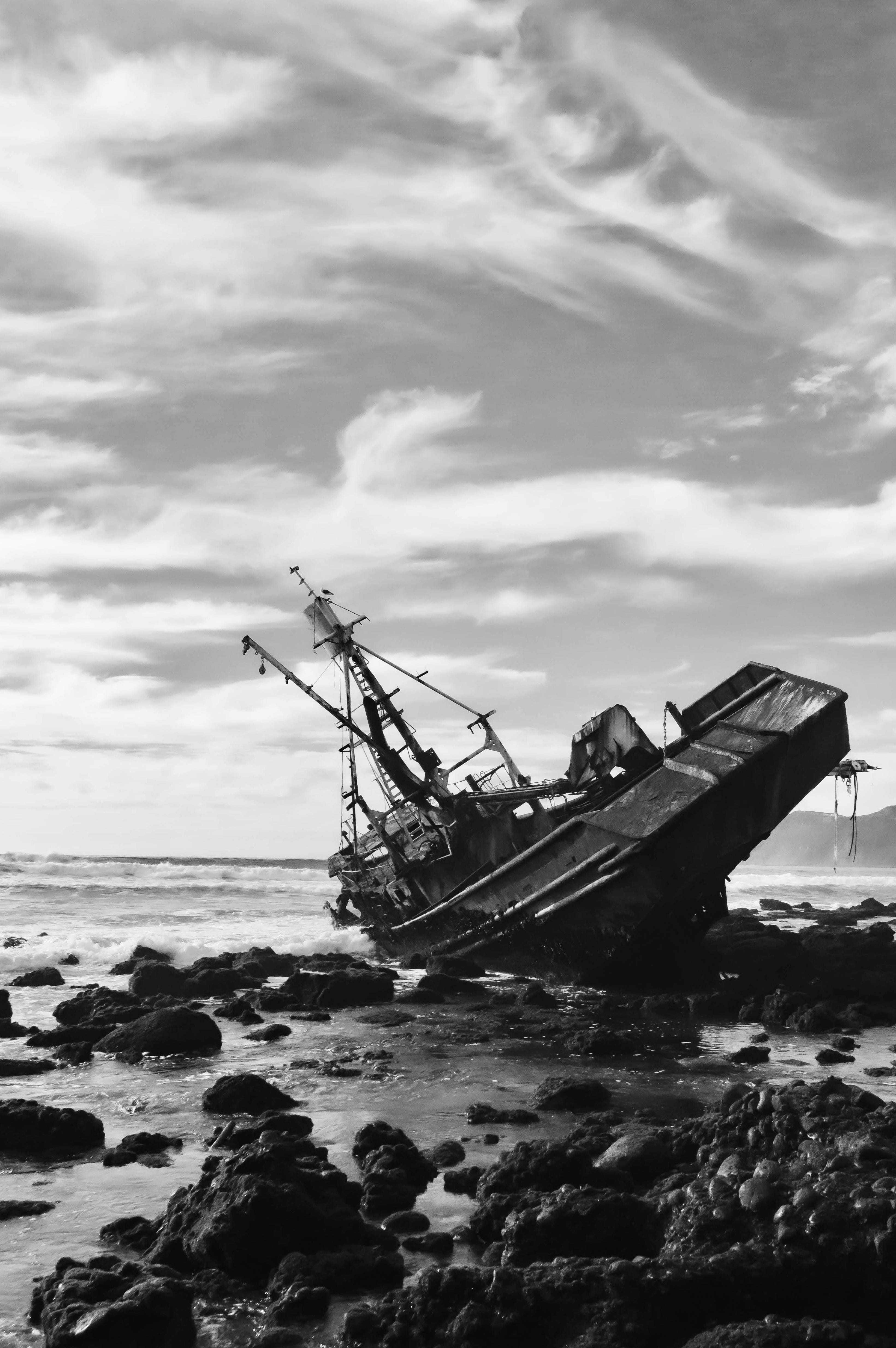
There Goes Me Ship
There was a particular season in my life when the various domains—professional, financial, relational, parental, administrative—all arrived at a point of simultaneous and unrelenting demand. Not one of these demands was illegitimate. Each belonged to a life I had chosen and valued. Three boys—seven, seven, and ten—each with their own distinct personality, their own needs, their own school rhythms, their own emotional world that deserved a father who was genuinely present and not merely physically accounted for. Soccer matches and school projects and bedtime conversations and the ten thousand small moments that constitute a child’s experience of being known and loved. I wanted to show up for all of it. I was trying to show up for all of it. At the same time, clients were counting on me. Deliverables with real deadlines, businesses navigating real financial decisions, people who had trusted me with work that mattered. The kind of professional obligations that don’t pause because your personal life is complicated. And alongside client work, the firm itself—staffing, systems, business development, the accumulating administrative burden that every entrepreneur carries: regulatory compliance, tax filings, invoicing, collections, the quiet proliferation of obligations that seem manageable individually and crushing collectively. A business relationship built across years had begun to fracture in ways I had not anticipated, with implications that were both financial and deeply personal. A marriage under severe strain, both parties carrying more than either could adequately hold, both trying to navigate an impossibly difficult season with three children watching. And threading through all of it—the administrative backlog. The things deferred in quieter seasons that had accumulated into a weight that sat constantly in the background, unaddressed, compounding.
On any given day, the choices were impossible in their ordinariness. Do you attend the soccer match or finish the client deliverable? Do you rest for an hour or return the call? Do you stop for a real meal or keep moving because stopping feels like a luxury the day cannot afford? Do you reach out to a friend or defer again because you don’t have the words for what is actually happening? Each individual choice was manageable. The cumulative weight of making them all, across every domain, every day, with no margin left to absorb the unexpected. That was something else entirely.
What made this season distinct from ordinary difficulty was not the severity of any single element. It was the incomplete structure that was incapable of absorbing their simultaneous arrival. There was no margin left. There was no reserve. Every system I had, from financial, to emotional, relational, and operational, was operating at, or past, its limit. The patches I had been applying to the ship’s hull for years were no longer holding. And at a certain point, the Tetris screen topped out. The music stopped. The realization arrived not as a dramatic collapse but as a quiet, devastating clarity: the ship, as it was currently built, was not equipped for these waters. I was not going to outwork this. I was not going to hustle my way through it. The default strategy that had served me, effort, resilience, and compensation through sheer force of will, had reached its limit. Something more fundamental was needed. I was, in a word, shipwrecked.
Rightly or wrongly, I do believe that a person with adequate structure, with genuine margin, with sustained rhythm and cadence, with a ship built proportionate to the waters they were sailing, would have navigated that same season differently. Not without difficulty. Not without cost. But with enough reserve to respond rather than merely react. With the capacity to address one thing at a time rather than being overwhelmed by all of them converging at once. I did not have that architecture. And that season showed me, with a clarity I could not dismiss or defer, what the absence costs.
Game Over - Please Try Again
What changed was not a single insight. Not a book or a methodology or a new system. It was slower and more human than any of those things, and looking back, I can see that the process of rebuilding was itself a preview of the architecture this series will describe.
The first thing it required was nervous system safety. Not productivity. Not strategy. Before any planning or rebuilding could begin, the body needed to find its way out of the chronic activation it had been living in. This meant slowing down in ways that felt terrifying when the list was still long. It meant learning to tolerate the discomfort of not addressing everything, not because the things didn’t matter, but because a system running on emergency power cannot also run a full rebuild.
It took community, people who offered what Porges might call genuine co-regulation. People who saw me clearly and did not look away. Not people who offered optimized solutions, but people who were simply present, honest, and willing to stay. Friendships of genuine accountability, not the accountability of performance metrics, but the accountability of being known, being asked difficult and honest questions, and being expected to answer honestly.
The nervous system, it turns out, regulates most effectively in the presence of safe relationships. This is not a productivity insight. It is a biological one. And it took professional support, therapy, coaching, the patient work of understanding not just what I was doing but what was happening within my interior life as I did it. Learning, gradually, to bring language to the experience rather than simply pushing through it. To recognize the signals the body was generating, not as inconveniences to be managed but as meaningful information about the gap between load and structure.
Dr. Peter Levine’s insight, that the body holds what the mind cannot yet process, became less abstract and more personally relevant with each passing month, and it took learning how to rest before I felt I had earned it. Something that initially felt like exposure therapy to genuine restoration, play, and presence, without the permission structure of a completed to-do list. It involved learning that the guilt that arrives when you rest without apparent justification is not a moral signal. It is a symptom. Of the nervous system, trained by years of urgency driven living, struggling to locate the off switch even when the switch is finally available.
Integration, I came to understand, is not a reward for the other four kinds of work. It is a prerequisite for them. And it took making peace, not just intellectually, but genuinely, with the honest length of the journey ahead.
The shipwreck was not the end of the story. But rebuilding a ship is not an afternoon project. It is a sustained, patient, piece by piece endeavour that requires accepting help, acquiring new capacities, and being honest about what the previous vessel was missing. The keel had to be relaid. The confrontation work had to be faced rather than deferred. The administrative backlog had to be addressed systematically rather than reactively. The daily rhythm had to be designed rather than improvised. Each component of the rebuild, I would discover, connected to the others in ways that only became clear as the architecture began to take shape.
I had to peace with the length of that journey, choosing daily engagement with imperfect and provisional tools over paralysis or denial, which itself was a form of stewardship. Perhaps the first genuine one.
Eventually, I felt the weight of the full realization, that the snowboard life I had wanted in my twenties was never actually available to me, given the life I was carrying; and, that the optimized, scheduled, military logistics life I had rejected with equal conviction, was also not the answer.
It was becoming much more clear to me that there was a third way, not free-flow intuition nor joyless efficiency, but the beginnings of a third way, that I had started to catch glimmers of when I first stayed at that co-working space in 2022. This third way, that I have been slowly, imperfectly, working toward ever since, is what this series is about.
Where We Are Headed
Here is a brief and honest picture of what this series is building toward. The people I observed in that co-working space were not all carrying complex lives. Some were living relatively simply. And yet what I noticed, across the full range of those I encountered, was something that surprised me.
Fragmentation was not correlated with complexity.
There were people living simply who were nevertheless fragmented, scattered, avoidant, drifting, and coming undone by internal and external factors that had nothing to do with the volume of their obligations. But there were also people carrying genuine complexity who moved through their days with something that looked like elegance and artful competence.
This told me something important. Simplicity, while it has genuine wisdom and a proper place, is not the core of the answer.
A person can live simply and be fragmented. A person can live with complexity and be whole. The variable is not the load. It is the architecture proportionate to the load. What they had, those who seemed to carry their lives well, in different combinations, to different degrees, was structure. Proportionate to their load, built through experience or deliberate practice, refined over time. An architecture that allowed them to hold all of it without being held by it.
Some had developed it early, through families that modelled these rhythms implicitly without ever naming them. Others had built it deliberately across years, sometimes in real time, sometimes in advance of known changes ahead. The ship had been constructed and refined across the whole of the journey, not assembled in the middle of a crisis.
That is the horizon this series is walking toward.
Not a rigid architecture universally applied to everyone. And not a choose your own adventure where anything goes.
At its foundation are principles and relationships that are genuinely universal, yes, like the consequence of avoidance, the necessity of margin, the constraint principle, the sequencing of different kinds of work, the value of honest self-knowledge, the requirement of cadence and daily discernment. These are not personal preferences. They are features of what it means to be a finite, responsible, purpose-driven human being carrying genuine obligations across time. And I believe they will hold whether you are a physician or a photographer, whether you have two active domains of responsibility or twelve. What will vary, however, is the surface implementation, the specific tools, the particular apps or notebooks, the exact configuration of your weekly rhythms, the specific domains and ongoing responsibilities that constitute your life. These will differ across seasons and across individuals. Some approaches that serve well at one stage of life will be revised at another. The implementation is personal. The principles beneath it are not. Like the ancient ships of the Mediterranean Bronze Age and classical era, the keel, the precision joinery, the hull built from the foundation up, these are like the principles. But the specific timbers, the particular dimensions, the rigging suited to your specific waters, these are the implementation. No two ships are identical. But every seaworthy ship shares the same underlying logic of construction. And a ship built without that logic, however confidently it sets sail, will eventually reveal what it was missing.
The measure of success is not whether your architecture is perfect. The measure of success is whether, at some point during or after this series, you sit down with your notebook, or your equivalent, look at the day ahead, and notice something different in how it feels. Not the overwhelm. Not the vague guilt. Not the ambient anxiety or the sense of being perpetually behind. Not the longing for three years of rest that isn’t coming. Not the particular loneliness of trying hard and feeling, quietly, that it still isn’t quite enough. But something closer to peace. Clarity. Courage. The particular quiet confidence of a person who knows what they are carrying and how they intend to carry it. Equipped, finally, for the waters ahead.
A Commitment
I have spent three essays sitting with various facets of the problem. Naming it, tracing its probable roots, identifying the gap in existing answers, and describing what sustained fragmentation can cost at its worst.
For those of you choosing to continue with this series, the essays that follow will begin building something. Not prescribing a single system or insisting on a particular method. Not promising that what will be explored is entirely new, because most of the components, taken individually, will likely be recognizable. Time blocking is not new. Weekly reviews are not new. Life domains are not new. The refined habit of a physical notebook is not new. Even the five archetypes of work, in their underlying categories, reflect experiences of human labour that predate any framework.
What I donhope is new, however, is the precision with which they are named, the completeness of the set, and the integrated understanding of how they affect each other and the whole of a stewarded life.
What I am proposing is the integration of these and other components into a coherent, complete architecture of stewardship, one designed not merely to be understood, but to be built and lived in. One that is proportionate to genuine complexity. One that honours all five archetypes of work a whole life requires, including the kinds that most productivity approaches most consistently neglect: confrontation and integration. An architecture rooted not in efficiency, but in the deeper question of what it actually means to carry a life well.
Just as a mathematics education encompasses years spent on individual units—arithmetic, algebra, geometry, trigonometry—each making sense within its own context, the connection between them is not apparent until later. But when calculus arrives, the earlier units are suddenly revealed as components of something larger and more powerful than any of them individually suggested.
The student who only took algebra cannot solve certain problems. But the student who worked through all the units and then encountered their integration can, because they have something qualitatively different from a collection of useful tools. They have a coherent competency and capacity.
As such, each essay from here forward will be a unit. But each unit alone is not the point. The integration is the point.
And by the time this series has run its course, my hope is that, not only will you understand this architecture from a theoretical vantage point, but that you will have examined your own relationship to how you are stewarding the primary domains of your life, that you will have built your own version of the architecture, rooted in what I believe are timeless principles, and that you will feel something positive and perhaps, as I have started to, unfamiliar. A much more clear sense of what you are responsible for versus what you are not. A better understanding of what is within your control versus what isn’t. No longer sitting with the overwhelm or the vague guilt or the ambient anxiety, but equipped, engaged, and present. Carrying what is yours to carry, as the capable captain of a ship that has finally been built for the waters ahead. Not because the waters have become calmer. They rarely do. But because the ship you are sailing has finally become proportionate to its journey.
Even as I write these essays, I am in the midst of my own building journey. The ship is not finished. There are planks still being fitted, joints still being tested, sections of the hull that are more seaworthy than they were a year ago and others still under construction. This is not a series written from the other side of the problem. It is written from inside the work, by someone who has done a great deal of it, who has found genuine ground to stand on, and who still has genuine distance to travel.
For those of you who find yourselves somewhere on the open water, further along than you were, not yet where you are headed, you are in good company, and you are invited to build.