Essay Two | Technique, Hustle, Rat, Butterfly

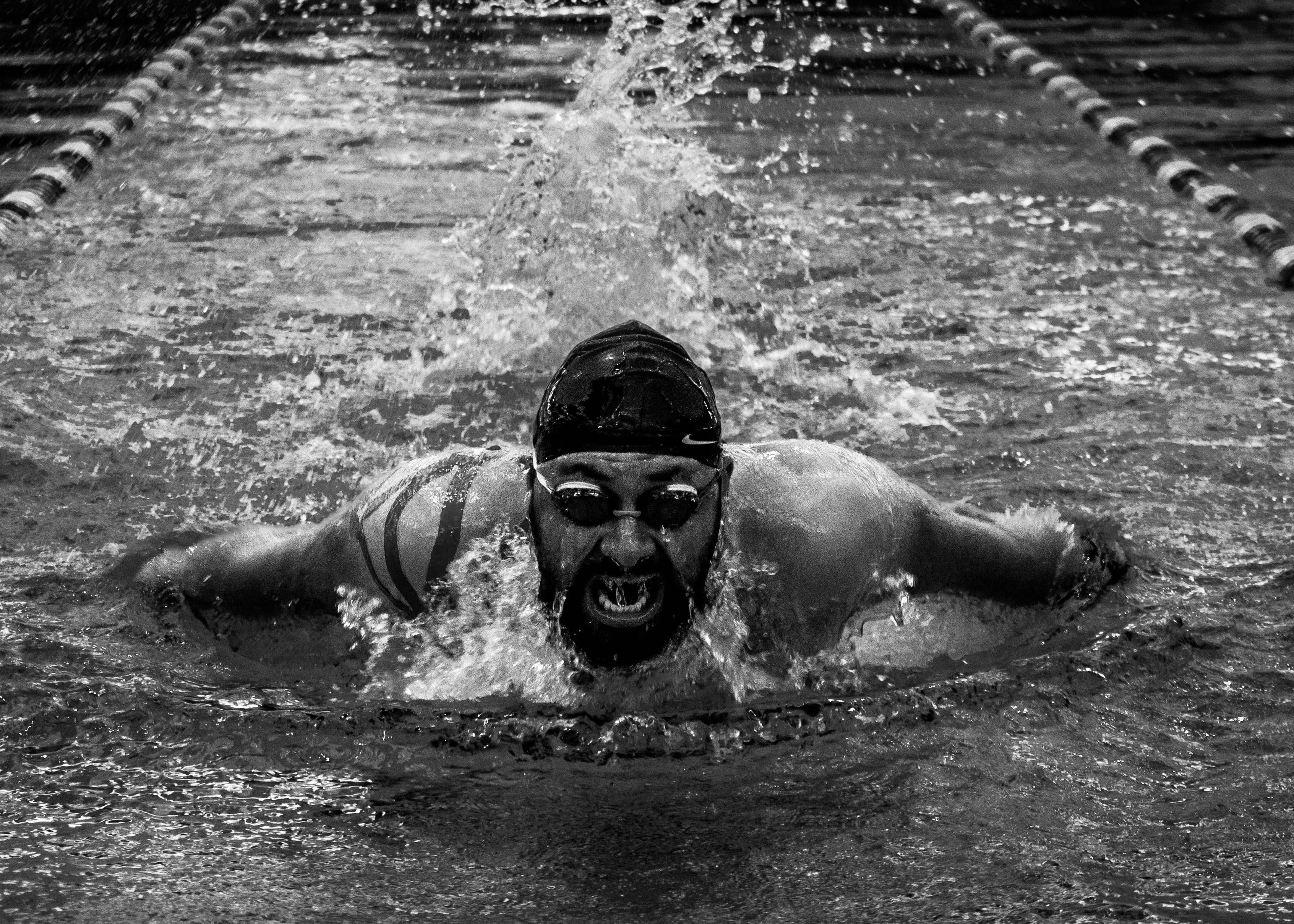
During my early to mid twenties, I imagined that a key component of the ideal life, a life that is lived to the fullest, would be one that encompasses a certain free-flow and intuitive form of living. The kind of life where mornings arrive without a script. Where the day unfolds organically, shaped by energy and curiosity rather than obligation and calendar. Where meaningful work happens when inspiration is present, rest happens when the body asks for it, and connection happens naturally—not because it was scheduled three weeks in advance between a conference call and a dentist appointment. A life responsive to the moment rather than hostage to a plan. Metaphorically, I would liken it to the feeling I get when snowboarding on a powder day in the backcountry—intuitive, responsive, effortless—rarely any thought about technique or training. Quite the sharp contrast to my experiences in competitive swimming, which had consumed much of my teenage years. But I’ll return to this shortly.

I will admit that at the outset of adulthood, I was quietly suspicious of people who organized their lives with almost zealous intensity—people who scheduled everything, tracked everything, optimized everything. It seemed like a kind of joyless over-engineering. A refusal to simply live. I was put off by my own assumption that the scheduling and order were being valued more than the life being scheduled. An existence, I thought, that had become subservient to the system, rather than the other way around.
And so I told myself that just wasn’t for me—I wanted the backcountry snowboard life.
In reality, however, what unfolded was something considerably more complicated—neither the snowboard life nor the optimized and scheduled life. Something else entirely.
Compounding Responsibilities, Compounding Complexities
Having completed my academic studies, a professional accounting designation, and my articling requirements with a public accounting firm, I was in my mid to late twenties when the weight of adult responsibility began to compound in earnest. I was living in Winnipeg, having recently left the accounting firm to join a real estate asset management firm. I was also teaching a fourth-year accounting course at the University of Manitoba as a sessional instructor. My son was two, and we were expecting twin boys, mid-renovation on our house, racing to have everything ready before the twins arrived. The days were full and life felt genuinely meaningful—but also structurally chaotic, somewhat precarious, with any sort of margin continuing to diminish as each month passed. There were too many legitimate demands moving simultaneously, and my approach to managing them was essentially improvisational hustle.
As a matter of caution, I will pre-emptively clarify. My intent is not to share this as some sort of extraordinary catalogue of hardship. Many people navigate seasons far more demanding, and even with remarkable steadiness. What I noticed wasn’t the weight itself. It was the gap. The distance developing between the responsibilities of my life and my actual capacity to carry them with the kind of artfulness I had hoped for.
I was showing up, I was well-intentioned, and I was trying very hard—but still, the cracks were starting to become visible. My so-called snowboard approach—intuitive, free-flowing, responsive as things arose—was simply not working. And rather than feeling free, I felt trapped.
The question that had been quietly forming during my morning bus commutes to the accounting firm years earlier was no longer theoretical. It had become immensely practical and operational.
How did people do this? What was I missing?
A Landscape of Insights
Over the years that followed, I encountered a considerable body of serious thinking on these questions. I want to be honest about what each contributed, and equally honest about where each left me still searching.
The first that genuinely changed my thinking was David Allen’s Getting Things Done. What Allen did—and it sounds almost embarrassingly simple in retrospect—was reveal that the mind is a poor filing system. It is not designed to hold open loops. Every unresolved commitment, every task without a designated home, every project without a clear next action, consumes processing power whether we intend it to or not. The solution is not to think harder. It is to build external systems that can hold what the mind shouldn’t have to. GTD gave me a language for the architecture of projects and tasks that I simply hadn’t had before.
It was common sense I had never encountered explicitly.
It also complemented what I had encountered during my graduate work at the business school in Saskatoon—Stephen Covey’s Seven Habits of Highly Effective People, or rather, the epitaph exercise led by the dean of the program. She asked us to imagine, in concrete detail, what we would want people to say at our funerals. To work backward from the end of a life and ask: what kind of person do I want to have been? What responsibilities do I want to have honoured? What relationships do I want to have tended well?
That was the first time I had thought seriously about life domain—the distinct areas of a whole life that all require ongoing attention. Vocation. Family. Household. Personal health. Community. The exercise was clarifying in a way that genuinely surprised me. Sitting with those questions, I discovered that I did have answers. I had a sense, perhaps for the first time with any real clarity, of the kind of person I wanted to be—the kind of father, the kind of professional, and the kind of friend. The destination had a shape.
And that was both inspiring and quietly terrifying.
Inspiring, because the clarity felt like something solid to reach toward. Terrifying, because the distance between where I was and where I wanted to be was uncomfortably visible, and I had absolutely no idea how to close it.
Covey also introduced the Eisenhower Matrix—a simple framework that divides work into four quadrants based on urgency and importance. The insight that landed hardest was Quadrant Two: the important, but not urgent. The things that matter most for long-term flourishing—relationships, health, meaningful work, personal development—but that carry no immediate deadline and therefore lose, almost every time, to whatever happens to be on fire that day.
I recognized myself immediately in that description. I was living almost entirely in the urgent half of the matrix, responding to whatever demanded attention, while the genuinely important things quietly waited.
I left the workshop with clarity about the destination but no operational understanding of how to navigate there on an ordinary Tuesday. I knew what mattered. I had no architecture for honouring it.
There was also, I’ll admit, a more immediate obstacle. A friend and I had a running joke around that time—we were both spending what felt like a severely disproportionate amount of time grinding through the professional designation exams and articling requirements. It went something like this: “Phillip, we just need to get past this one hurdle, and then it’s all clear sailing from here on out.” We said it about every challenging exam. Every major deadline. Every season of intensity. But the joke eventually faded because we both quietly understood it was never going to be true. Each successive season brought compounding factors and complexities that made the previous one look manageable in retrospect. The Covey exercises left an imprint. But it was likely another decade before I engaged with them with any real seriousness. My focus at the time was survival, just wanting to make it through.
Around the same period, I encountered Marshall Rosenberg’s work on nonviolent communication—first through a video workshop a family friend had shared, and later through reading Nonviolent Communication carefully. What Rosenberg offered was something different from productivity methodology entirely. A language for the interior life that I had been missing. A vocabulary for feelings, needs, wants, and the interconnected relationship between them. A framework for understanding not just what I was doing but what was happening within my internal emotional landscape.
This, I came to understand, was not optional equipment for navigating a complex life. The emotional weight of unfinished things, the avoidance of difficult conversations, the guilt and apprehension and low-grade dread—these were not character flaws to be overcome by increased discipline. They were signals. Meaningful ones. Pointing toward unmet needs, unresolved tensions, or responsibilities that had been deferred past the point of comfort. Without a language for that interior experience, those signals simply accumulated as ambient anxiety—something felt but unnamed, quietly draining energy without ever being addressed.
Somewhat related to this, I also worked through a series of self-knowledge frameworks, like the DISC Assessment, which helped me understand my own operating tendencies with greater precision—how I naturally processed information, where I instinctively avoided confrontation, what conditions brought out my best work and what conditions quietly depleted me.
It felt like reconnaissance. If I am going to steward my life well, I need to better understand the unique collection of facets of the person doing the stewarding—me.
Around the same time, I encountered thinkers and teachers who reframed the purpose of work itself—not merely as economic output, but as genuine contribution to the flourishing of others and of community. This too mattered, but it is a thread I will return to separately.
And finally, there was a quieter but equally important voice—one I encountered not through a book initially, but through a brief conversation. A psychologist in Winnipeg introduced me to the work of Richard Swenson, a physician who had written extensively about the effects of overloaded lives. In our conversation he quoted Swenson on the concept of margin—the unstructured space between obligations where so much of what matters most actually occurs. Creativity, rest, genuine connection, reflection, play. These things rarely appear on a calendar or a task list. They inhabit the margins. Swenson’s diagnosis was precise and sobering: modern life can systematically eliminate exactly this type of space. When margin disappears, so does everything that lived inside it.
The idea landed immediately. I already knew from experience that it was true.
Each of these contributions was real. Each shifted something in how I understood the problem.
Allen addressed the capture and processing of tasks and projects. Covey addressed values clarification and the prioritization of what matters most. Rosenberg addressed the emotional and relational interior. Self-knowledge frameworks addressed the self doing the navigating. Others pointed toward the deeper purpose of work itself. And Swenson diagnosed what was being lost when the load exceeded the structure available to carry it.
I am genuinely and deeply grateful for all of it—and yet.
The cracks and growing chasm remained. In part, I think, because I was already stuck in a loop of trying to apply partial solutions to a problem I hadn’t yet fully named. I recall having the thought: “if only I had understood even a fraction of this before all these responsibilities arrived and compounded”.
What none of them fully addressed—at least not in a way that answered my specific question—was the structural challenge facing a person who carries genuine, complex, ongoing responsibility across multiple life domains simultaneously. Not just a project, a season of busyness, or a single discrete challenge to be solved and set aside. But the permanent condition of an adult life with real stakes in multiple directions at once. And at that, for a person who, for some reason or another, does not find the overall answers to the matter of life stewardship available as a matter of free-flow intuition, common sense, or instinct.
And so—the question was not how to manage tasks more efficiently. The question, for me, was how to develop an architecture of stewardship—a set of rhythms and constraints proportionate to the full weight of what was being carried—that allows a person to move through their responsibilities with something resembling clarity and peace, rather than perpetual fragmentation. An architecture that preserves the margin Swenson identified as essential, rather than treating margin as a luxury to be enjoyed once the work is done—because the work is never done.
I kept finding that this question was either assumed to be answered by the adjacent frameworks, or not quite asked at all.
What the Butterfly Taught Me
I was fourteen when I first learned the butterfly stroke as a competitive swimmer. My coach—a man not known for excessive diplomacy—reviewed footage of my early attempts and delivered his assessment with characteristic precision.
“Bshouty, I hate to break it to you, but you look like a drowning rat.”
He was not wrong.

What followed was a structured coaching plan. To compete in a fifty-meter butterfly race—perhaps thirty seconds of actual racing—I trained six days a week, sometimes twice a day. Swimming in the cold water training tank, and also through dry land cardio, strength, and mobility training. The preparation was radically disproportionate to the visible event. And so much of it was in service of technique. Not just fitness.
Technique—the precise sequencing of body movement that made the stroke functional and elegant rather than catastrophic. And if you mastered it, it could look effortless.
What I learned about the butterfly stroke that I did not fully appreciate at the time was that it is the one swimming stroke where hustle cannot compensate for missing technique. A poor freestyle swimmer can survive on extra effort and hustle. A technically deficient butterfly swimmer does not swim fifty meter—it would be more like thrashing their way across it, and then simply needing to stop.
The reverse is also true. Technically beautiful butterfly without the prerequisite strength, endurance, and conditioning will fade badly in the final meters. You need both, in proportion, or the race ends badly.
I was not even an A-class swimmer. The most I could qualify for was provincial B events. I was a teenage kid working hard at something technically demanding. What I earned—through the combination of technique and training—was not excellence. It was competence—the ability to complete the race with elegance, even if I didn’t place in the top three.
The parallel to life stewardship took me two decades to fully appreciate.
Raw effort, hustle, diligence, good intentions, and intelligence can compensate for missing structure when the responsibility load is light. The snowboard approach still works when the terrain is forgiving. But when the load becomes genuinely heavy, when multiple domains all require simultaneous attention, when the margins have narrowed and the stakes have risen—structure is no longer optional. Technique is no longer optional. The person relying on effort alone begins, slowly and privately, to really struggle.
And working harder is not the solution. The solution must be technique.
I want to pause one more time to acknowledge that not everyone will feel the weight of this question. Some people develop their architecture naturally and gradually—whether through upbringing or temperament or the fortunate alignment of increasing responsibility with developing structure. For them, much of this may feel like common sense. If so, I’m genuinely glad. The elegant mastery of life is real for some people and I have no interest in complicating what isn’t broken. In fact, I have found it helpful, motivating, and even mesmerizing the times I’ve been able to witness someone navigating a complex life with structure, cadence, competency and grace.
But for those of us who have felt the nagging dissonance—who have worked hard, carried real responsibility with good intentions, and still found themselves fragmented I want to share the principle I resisted for much longer than I should have.
It is not a new idea. Versions of it appear across centuries and disciplines—in political philosophy, in the arts, religions, and in athletic training. It keeps arriving because it keeps being true.
Liberty exists in proportion to wholesome restraint.
Or perhaps, a more contemporary version of the same idea, one I encountered some years ago and have not been able to dismiss since:
Freedom is not the absence of constraints. It is the presence of the right ones.
I resisted this instinctively. It ran directly against my snowboard sensibility. I wanted the open hill, the unstructured day, the life that moved without a manual. But the more honestly I examined my experience—the drowning rat, the accumulating margin debt, the gap between the frameworks and the actual question—the harder this principle became to dismiss.
There was something almost relieving about it, once I stopped fighting it. Not the constraint itself—but the possibility that the freedom I had been reaching for, might actually require it.
I will return to this idea at length in a later piece. But for now, I want to leave it sitting here, quietly, as the seed of where this series is headed.
The question is not whether to accept constraints. The question is which ones actually fit.
Well written, very intellectual…perhaps the part you may be missing, or at least not mentioning enough?, is having 3 young boys to manage. This is the proverbial spanner in the machine. Having also parented 3 young humans, I simply don’t believe there is any framework that can be applied to such a pursuit. It is utter chaos and you are right to say “survival”.Particularly when you are matching the “getting of the professional designations” followed by “doing the professional work” with welcoming kids into the mix and trying to find a way to get to it all. You are a hands on, involved father, your boys benefit from this. You did great. Keep going.
Amazing writing! You’re a natural.